
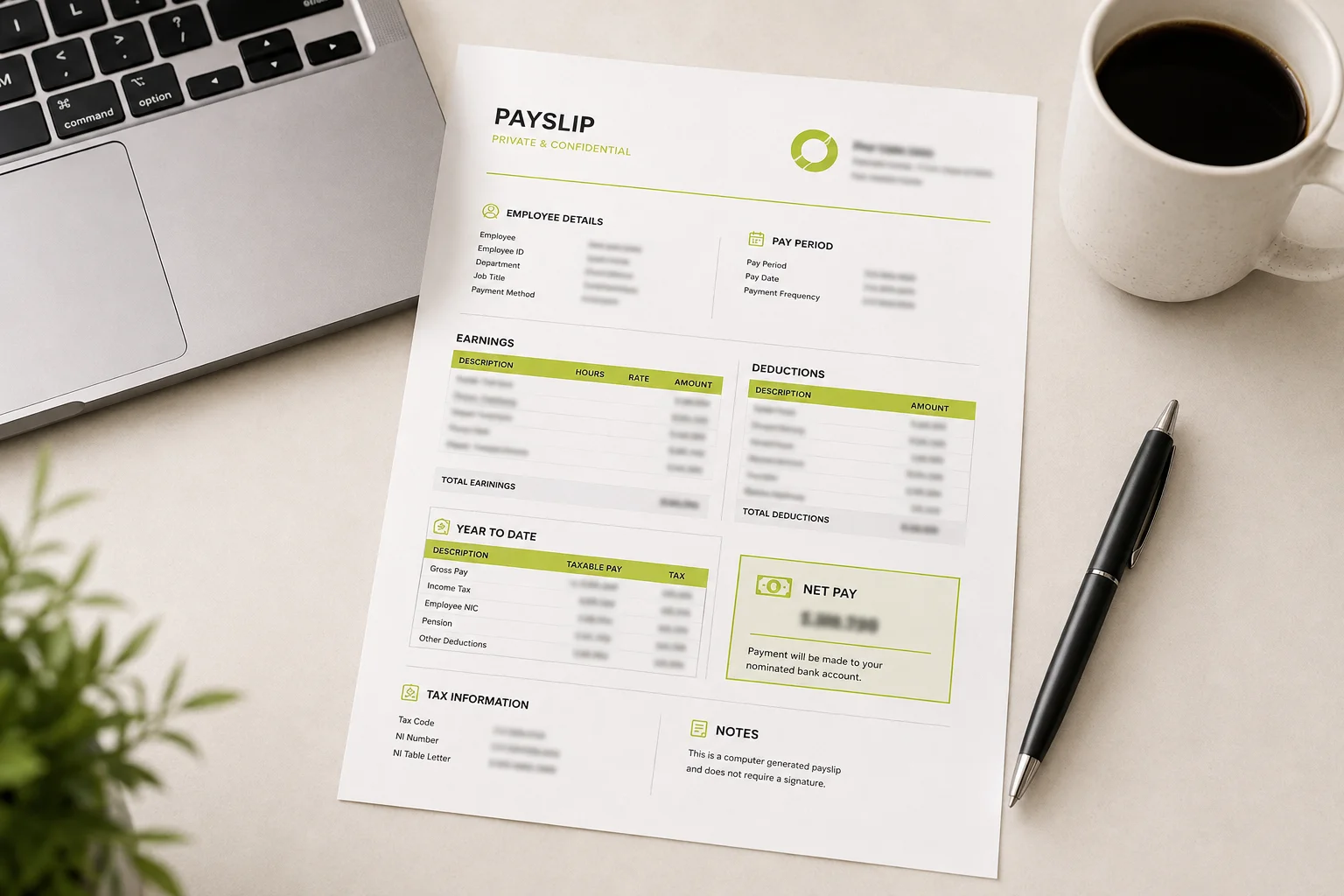
Starting your first job in the UK is exciting – until the first payslip lands and the number in your bank account is smaller than the salary you agreed to. If you’re feeling confused, you’re not alone. UK payslips and tax can look intimidating at first, especially if you’ve moved from a country with a different system. This guide walks you through every line on a typical UK payslip, explains how PAYE and tax codes work, and shows you exactly where your money goes – so you can check that you’re being paid, and taxed, correctly.
Please note: Tax rates, thresholds and National Insurance rules change at government Budgets. The figures below reflect the current position but should always be confirmed against the official source at GOV.UK before you rely on them.
Gross Pay vs Net Pay: The Two Numbers That Matter
Every payslip has two headline figures, and mixing them up is the most common source of confusion for new employees.
- Gross pay is your salary before anything is taken off. This is usually the figure quoted in your job offer.
- Net pay (often labelled “take-home pay”) is what actually lands in your account after tax and other deductions.
The gap between the two is made up of deductions – mainly Income Tax and National Insurance, and sometimes pension contributions or student loan repayments. Understanding that gap is the whole point of reading your payslip.

What Is PAYE?
PAYE (Pay As You Earn) is the system your employer uses to collect Income Tax and National Insurance directly from your wages before paying you. Instead of you filing a tax bill at the end of the year, your employer sends the tax to HMRC (His Majesty’s Revenue and Customs) on your behalf, every pay run.
For most employees this is automatic – you don’t need to do anything. But automatic doesn’t mean error-free, which is exactly why you should still learn to read your payslip.
Income Tax: How Much Comes Off
The UK uses a tiered (“progressive”) system – you pay a higher percentage only on the income above each threshold, not on your whole salary.
For the current tax year (2025/26), the widely published figures are:
- A tax-free Personal Allowance – the first slice of your annual income you pay no Income Tax on (currently around £12,570).
- A basic rate of 20% on income above the allowance, up to roughly £50,270.
- A higher rate of 40% on income above that band, up to around £125,140.
- An additional rate of 45% on income above the top threshold.
(These bands apply to England, Wales and Northern Ireland. Scotland sets its own Income Tax bands, so if you work in Scotland the rates differ – check GOV.UK for the Scottish rates.)
Because the thresholds are wide, most new graduates and early-career professionals will only pay the basic 20% rate. Always verify current allowances and bands at GOV.UK, as they are set at each Budget.
Understanding Your Tax Code
Your tax code tells your employer how much tax-free income you’re entitled to. It appears on your payslip and usually looks something like 1257L.
- The numbers (e.g. 1257) roughly represent your tax-free allowance divided by 10.
- The letter (e.g. L) describes your situation – L is the standard code for someone entitled to the normal Personal Allowance.
Watch out for “emergency” tax codes
When you start a new job – particularly your very first UK job – you may be put on an emergency tax code (you might see codes ending in W1, M1, or X). This can happen if HMRC doesn’t yet have full details of your income, and it often means you’re temporarily taxed more than you should be.
The good news: it’s almost always corrected automatically once HMRC has your details, and any overpaid tax is refunded through your pay. If it isn’t fixed within a couple of pay cycles, contact HMRC or ask your employer’s payroll team. Handing your new employer a P45 from a previous UK job (or completing a starter checklist if you don’t have one) helps prevent this.

National Insurance Contributions (NICs)
National Insurance is a separate deduction from Income Tax. It funds state benefits like the NHS and the State Pension, and paying it builds your entitlement to those benefits over time.
As an employee, you typically start paying National Insurance once your earnings pass a weekly/monthly threshold aligned with the Personal Allowance. The current main employee rate is around 8% on earnings between the primary threshold and the upper earnings limit, dropping to 2% on earnings above that upper limit.
Like Income Tax, these rates and thresholds change – confirm the current figures at GOV.UK. You’ll also have a National Insurance number (a unique reference like AB123456C); if you’re new to the UK and don’t have one yet, you can still start work, but you should apply for one promptly.
Other Deductions You Might See
Beyond tax and NI, your payslip may show:
- Pension contributions – under auto-enrolment, most UK employers automatically enrol eligible workers into a workplace pension and deduct a percentage of your pay (with the employer usually adding a contribution too). You can opt out, but the employer top-up is effectively free money, so think carefully first.
- Student loan repayments – only if you have a UK student loan and earn above the repayment threshold.
- Salary sacrifice items – such as cycle-to-work schemes or additional pension contributions.
How to Read Your UK Payslip: A Quick Checklist
Each pay period, take 60 seconds to confirm:
- Gross pay matches your agreed salary (pro-rated for the period).
- Your tax code is correct and not stuck on emergency (W1/M1/X) longer than expected.
- National Insurance is being deducted and shows your correct NI number.
- Net pay equals gross pay minus all listed deductions.
- Year-to-date (YTD) totals are climbing sensibly across the tax year.
If something looks wrong, don’t panic – most errors are down to missing information and are quickly fixed by payroll or HMRC.
A Note for International Employees
If you’ve recently moved to the UK for work, two extra points are worth knowing:
- Your residency status can affect how you’re taxed, particularly in your first year. If your situation is complex (income in more than one country, for example), consider speaking to a qualified tax adviser.
- Keep every payslip and your P60 (an annual summary you receive after each tax year). You’ll need these for visa renewals, mortgage applications, and proving your income.
Getting to grips with UK payslips and tax early makes you a more confident employee – and helps you spot the occasional error before it costs you money.
Frequently Asked Questions
Why is my take-home pay lower than my salary?
Your quoted salary is your gross pay. Income Tax, National Insurance, and often pension contributions are deducted before you’re paid, leaving your lower net (take-home) pay.
What does the tax code 1257L mean?
It’s the standard tax code for most employees, indicating you’re entitled to the usual tax-free Personal Allowance. The “1257” reflects that allowance and “L” marks a standard entitlement. Confirm your own code is correct on your payslip.
I’ve been put on an emergency tax code – what do I do?
Emergency codes are common when starting a new job. They usually correct automatically once HMRC has your details, and any overpaid tax is refunded through your pay. Give your employer a P45 or complete a starter checklist to speed things up.
Do international workers pay UK tax differently?
Everyone working in the UK pays Income Tax and National Insurance through PAYE, but your residency status can affect the finer details, especially in your first year. For complex situations, seek advice from a qualified tax professional and always check current rules at GOV.UK.
Where can I check the current UK tax rates?
Always use the official government source: GOV.UK Income Tax rates and National Insurance rates. Rates change at government Budgets.
Need help navigating your UK career, from your first payslip to your next role? Job Bridge Recruitment supports international students and professionals at every step. Book a call with our team.
